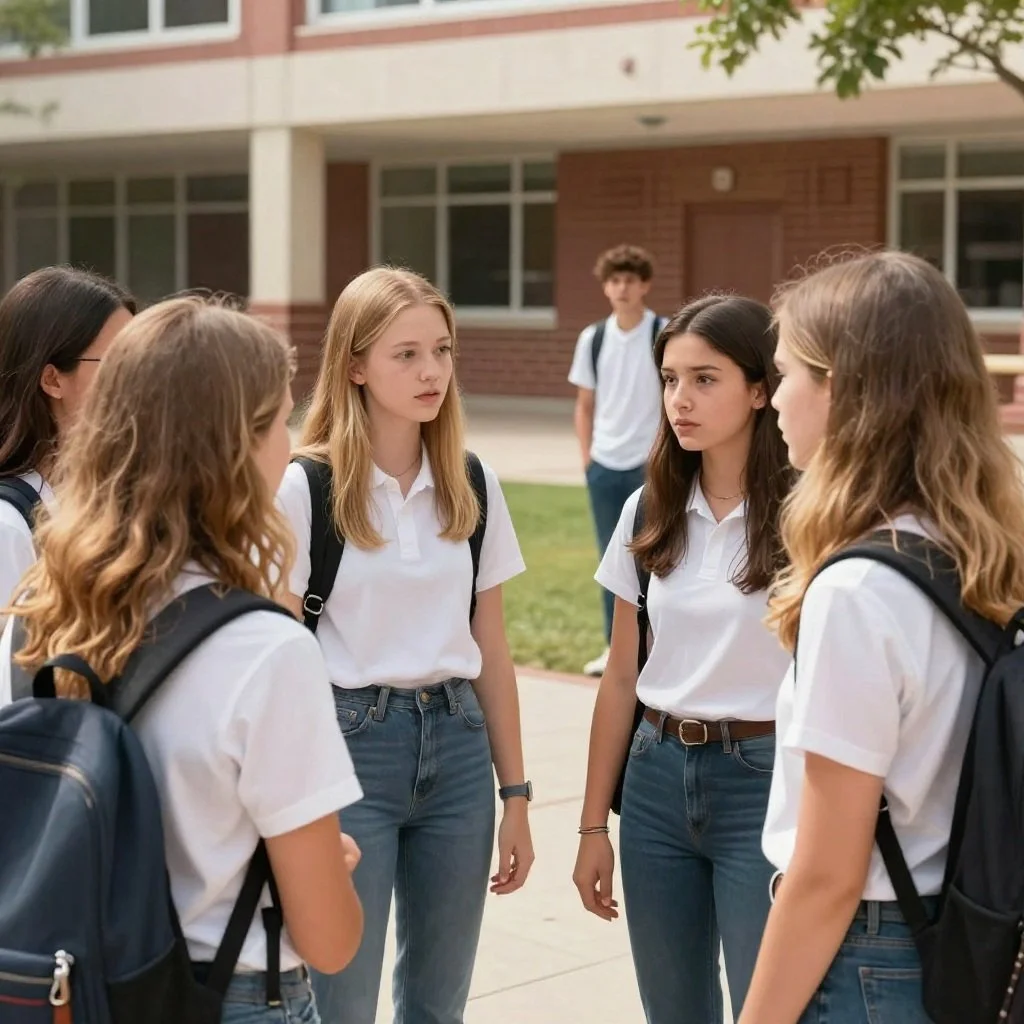
First
First
A Grace Lantern Story
---
The thing about firsts is that nobody warns you how loud they are.
Willow found out about Gavin on a Tuesday, which felt wrong. Tuesdays were supposed to be ordinary — coffee with Zoe before first period, the smell of dry-erase markers in AP English, the particular drag of the afternoon when the school day had gone on too long. Tuesdays were not supposed to be the day everything shifted.
"I heard him telling Marcus he was thinking about ending things," Zoe said, stirring her iced caramel latte with a straw, not quite meeting Willow's eyes. "Like, not in a mean way. Just — I heard it."
Willow wrapped both hands around her cup. The coffee was warm. She focused on that.
"How long ago?"
"Like, two days ago."
Two days. He had been holding that thought for two days, laughing with her in the hallway, texting her good night, all while carrying something he hadn’t said out loud to her. He had said it to Marcus first.
She drove home that afternoon and sat in the driveway for ten minutes before going inside.
---
She broke up with him on a Wednesday.
She had rehearsed it, which in retrospect felt both smart and a little sad. She stood at her mirror the night before and said the words to herself until they stopped shaking. “I think we both know this isn’t where it’s supposed to go.” Clean. Honest. A door held open, not slammed.
Gavin looked at her for a long moment when she said it. Something moved across his face — surprise, then hurt, then something harder that she didn’t have a name for yet.
"Okay," he said.
Just okay.
She walked away feeling strangely steady. She had done it. She had acted before he could, had protected herself the way Nana was always telling her to. “Know your worth before someone else tries to set the price, baby.” She had known. She had moved.
She told Zoe that night over FaceTime and Zoe said, "I’m proud of you."
Willow believed her. For about four days, she believed her.
---
The ghosting started quietly, the way most painful things do.
He stopped responding to the occasional text — not the big ones, just the small, harmless ones. A meme she sent because it reminded her of a joke they had. A song. Nothing that required a response, really, but he used to respond anyway. Now the messages sat there, gray and delivered, and nothing came back.
Then came the hallway. She saw him by the water fountains on a Friday and lifted her hand in a small wave, the kind that asks nothing, that just says I see you and I don’t hate you. He looked at her, and then he looked away. Kept walking.
Willow turned to her locker and opened it for no reason. Stared at her books. Closed it.
That night she lay in bed and did the thing she had promised herself she wouldn’t do, which was replay everything. The first time he had made her laugh so hard she couldn’t breathe. The afternoon they had sat on the hood of his car watching the sky go dark. The way he said her name like it meant something.
Had she been wrong? Had she acted too fast, too proud, too guarded? Maybe he hadn’t actually been planning to end things. Maybe Zoe misheard. Maybe she had thrown something good away because she was scared of being left first.
The questions were loud. They were so loud.
She texted Nana at 11:47 p.m., which she would do when things felt too big to hold alone.
Nana, did I make a mistake?
Nana replied within minutes because Nana always did.
What does your gut say, Willow-bird?
Willow stared at the question for a long time. Her gut said she had done the right thing. But her heart was making a lot of noise over her gut, and it was hard to hear anything
clearly.
I don’t know,
she typed back.
Yes you do. You just don’t like the answer yet. Get some sleep. I love you
---
The wanting-him-back phase lasted about three weeks, which felt like three years.
It was not that she missed Gavin exactly. When she was honest with herself — really honest, the way Nana had taught her to be — she missed the feeling more than the boy. She missed being someone’s person. She missed the warmth of being chosen. She missed the version of herself that existed inside of being liked by someone who made her nervous in a good way.
But Gavin had gone cold and stayed cold. And the coldness was doing something to her sense of reality. It was making her rewrite history, sand down the edges of things she had noticed, talk herself out of the knowing that had made her act in the first place.
She called Nana on a Sunday afternoon, sitting cross-legged on her bed with a cup of coffee going cold on her nightstand.
"He looked right through me again," she said. "Like I’m nothing."
Nana was quiet for a moment. Then she said, "His reaction to your decision is not a verdict on your decision."
Willow wrote it down. She kept a small journal, spiral-bound, blue cover, full of things Nana had said over the years. She wrote it down because she knew she would need it again.
His reaction to your decision is not a verdict on your decision.
"He’s hurting," Nana continued. "Hurt people do cold things. That doesn’t mean you were wrong. It means he’s human and so are you."
"I just keep thinking if I hadn’t done it first—"
"You’d be sitting here having a different kind of hurt," Nana said. "One where he did it and you were blindsided. Which would you rather carry?"
Willow didn’t answer. But she knew.
---
It was Zoe, of course, who started the thaw.
"Come Saturday," she said one morning in the coffee shop, three weeks after the hallway incident, spinning her cup in slow circles on the table. "Tatum’s having people over. Low-key. There’s someone I want you to meet."
"Zoe."
"I’m just saying."
"I’m not ready."
"You don’t have to be ready. You just have to show up."
Willow showed up.
His name was Daniel. He was a friend of Tatum’s older brother, a junior from across town, and he had a quiet kind of confidence that didn’t demand anything from her. He made her laugh twice in the first twenty minutes — not the nervous, performed laugh she sometimes used around boys she was trying to impress, but the real one, the one that surprised her coming out.
They talked for two hours about nothing important: a show they had both seen, a restaurant on the east side, whether cold brew was objectively better than hot coffee (she said yes, he said it depended on the season, which was a wrong answer but she let it go). When she drove home that night the windows were down and the air was cool and she realized somewhere on the highway that she hadn’t thought about Gavin once.
Not once.
She sat in her driveway — the same driveway — and this time she was smiling.
---
She didn’t text Nana that night. She called her the next morning instead, coffee in hand, standing at the kitchen window watching the backyard fill up with Sunday light.
"Something shifted," she said, and she didn’t know quite how to explain it. "I don’t know if it’s Daniel or just — time. But I feel like myself again."
"You never stopped being yourself," Nana said. "You just got a little loud in your own head for a while. That happens."
"I was so close to going back to him."
"I know."
"What would have happened if I had?"
Nana made a small sound, soft and knowing. "You would have learned the same lesson on a longer road. God has a way of teaching us what we need to know. Sometimes He protects us from what we asked for."
Willow turned that over in her mind the way she turned over all of Nana’s words — slowly, checking the weight of them.
She had prayed once, in the thick of the worst week, not a big formal prayer but a small desperate one, the kind that slips out when you’re lying in the dark and you don’t know what else to do. Just help me know what’s true. Help me trust what I already know.
She hadn’t heard anything back. No voice, no sign. Just ordinary days that kept arriving, and Zoe with her iced lattes and her good ideas, and Daniel laughing at something she said, and the window this morning with the light coming through it.
Maybe that was the answer. Maybe it always had been.
"Nana," she said, "did you ever have a Gavin?"
A long pause. Then a laugh, warm and full. "Baby, I had three."
Willow laughed too, leaning against the counter, coffee warm in her hands.
"And look at you," Willow said.
"And look at me," Nana agreed. "Still here. Still standing. Still knowing my own worth."
---
The thing about firsts is that they feel final when you’re inside them. Like the feeling will never change shape, like the version of you that is hurting is the only version there is.
But Willow was sixteen, and she was learning something important: that she had good instincts, and that doubt is not the same thing as being wrong, and that sometimes God answers a quiet prayer not with thunder but with a Saturday night and a friend who knows when you need to be somewhere new.
She had done a hard thing and survived the silence that followed.
She had stayed true to herself, even when it cost her something.
That was worth more than she knew how to say yet. But she was beginning to
understand it. And somewhere, in the small spiral notebook with the blue cover, she had the words to come back to whenever she forgot.
His reaction to your decision is not a verdict on your decision.
She was going to be just fine.
---
To every girl who ever did the right thing and then spent three weeks wondering if she did — you did. Trust the knowing.
Firstis Part One of a two-part series. Part Two — The Other Side of It — coming soon.
If this story moved you, share it with a girl who needs it. And come back to gracelanternco.com for more stories, wellness, and faith for everyday life.
Read more below
---
The thing about firsts is that nobody warns you how loud they are.
Willow found out about Gavin on a Tuesday, which felt wrong. Tuesdays were supposed to be ordinary — coffee with Zoe before first period, the smell of dry-erase markers in AP English, the particular drag of the afternoon when the school day had gone on too long. Tuesdays were not supposed to be the day everything shifted.
"I heard him telling Marcus he was thinking about ending things," Zoe said, stirring her iced caramel latte with a straw, not quite meeting Willow's eyes. "Like, not in a mean way. Just — I heard it."
Willow wrapped both hands around her cup. The coffee was warm. She focused on that.
"How long ago?"
"Like, two days ago."
Two days. He had been holding that thought for two days, laughing with her in the hallway, texting her good night, all while carrying something he hadn’t said out loud to her. He had said it to Marcus first.
She drove home that afternoon and sat in the driveway for ten minutes before going inside.
---
She broke up with him on a Wednesday.
She had rehearsed it, which in retrospect felt both smart and a little sad. She stood at her mirror the night before and said the words to herself until they stopped shaking. “I think we both know this isn’t where it’s supposed to go.” Clean. Honest. A door held open, not slammed.
Gavin looked at her for a long moment when she said it. Something moved across his face — surprise, then hurt, then something harder that she didn’t have a name for yet.
"Okay," he said.
Just okay.
She walked away feeling strangely steady. She had done it. She had acted before he could, had protected herself the way Nana was always telling her to. “Know your worth before someone else tries to set the price, baby.” She had known. She had moved.
She told Zoe that night over FaceTime and Zoe said, "I’m proud of you."
Willow believed her. For about four days, she believed her.
---
The ghosting started quietly, the way most painful things do.
He stopped responding to the occasional text — not the big ones, just the small, harmless ones. A meme she sent because it reminded her of a joke they had. A song. Nothing that required a response, really, but he used to respond anyway. Now the messages sat there, gray and delivered, and nothing came back.
Then came the hallway. She saw him by the water fountains on a Friday and lifted her hand in a small wave, the kind that asks nothing, that just says I see you and I don’t hate you. He looked at her, and then he looked away. Kept walking.
Willow turned to her locker and opened it for no reason. Stared at her books. Closed it.
That night she lay in bed and did the thing she had promised herself she wouldn’t do, which was replay everything. The first time he had made her laugh so hard she couldn’t breathe. The afternoon they had sat on the hood of his car watching the sky go dark. The way he said her name like it meant something.
Had she been wrong? Had she acted too fast, too proud, too guarded? Maybe he hadn’t actually been planning to end things. Maybe Zoe misheard. Maybe she had thrown something good away because she was scared of being left first.
The questions were loud. They were so loud.
She texted Nana at 11:47 p.m., which she would do when things felt too big to hold alone.
Nana, did I make a mistake?
Nana replied within minutes because Nana always did.
What does your gut say, Willow-bird?
Willow stared at the question for a long time. Her gut said she had done the right thing. But her heart was making a lot of noise over her gut, and it was hard to hear anything
clearly.
I don’t know,
she typed back.
Yes you do. You just don’t like the answer yet. Get some sleep. I love you
---
The wanting-him-back phase lasted about three weeks, which felt like three years.
It was not that she missed Gavin exactly. When she was honest with herself — really honest, the way Nana had taught her to be — she missed the feeling more than the boy. She missed being someone’s person. She missed the warmth of being chosen. She missed the version of herself that existed inside of being liked by someone who made her nervous in a good way.
But Gavin had gone cold and stayed cold. And the coldness was doing something to her sense of reality. It was making her rewrite history, sand down the edges of things she had noticed, talk herself out of the knowing that had made her act in the first place.
She called Nana on a Sunday afternoon, sitting cross-legged on her bed with a cup of coffee going cold on her nightstand.
"He looked right through me again," she said. "Like I’m nothing."
Nana was quiet for a moment. Then she said, "His reaction to your decision is not a verdict on your decision."
Willow wrote it down. She kept a small journal, spiral-bound, blue cover, full of things Nana had said over the years. She wrote it down because she knew she would need it again.
His reaction to your decision is not a verdict on your decision.
"He’s hurting," Nana continued. "Hurt people do cold things. That doesn’t mean you were wrong. It means he’s human and so are you."
"I just keep thinking if I hadn’t done it first—"
"You’d be sitting here having a different kind of hurt," Nana said. "One where he did it and you were blindsided. Which would you rather carry?"
Willow didn’t answer. But she knew.
---
It was Zoe, of course, who started the thaw.
"Come Saturday," she said one morning in the coffee shop, three weeks after the hallway incident, spinning her cup in slow circles on the table. "Tatum’s having people over. Low-key. There’s someone I want you to meet."
"Zoe."
"I’m just saying."
"I’m not ready."
"You don’t have to be ready. You just have to show up."
Willow showed up.
His name was Daniel. He was a friend of Tatum’s older brother, a junior from across town, and he had a quiet kind of confidence that didn’t demand anything from her. He made her laugh twice in the first twenty minutes — not the nervous, performed laugh she sometimes used around boys she was trying to impress, but the real one, the one that surprised her coming out.
They talked for two hours about nothing important: a show they had both seen, a restaurant on the east side, whether cold brew was objectively better than hot coffee (she said yes, he said it depended on the season, which was a wrong answer but she let it go). When she drove home that night the windows were down and the air was cool and she realized somewhere on the highway that she hadn’t thought about Gavin once.
Not once.
She sat in her driveway — the same driveway — and this time she was smiling.
---
She didn’t text Nana that night. She called her the next morning instead, coffee in hand, standing at the kitchen window watching the backyard fill up with Sunday light.
"Something shifted," she said, and she didn’t know quite how to explain it. "I don’t know if it’s Daniel or just — time. But I feel like myself again."
"You never stopped being yourself," Nana said. "You just got a little loud in your own head for a while. That happens."
"I was so close to going back to him."
"I know."
"What would have happened if I had?"
Nana made a small sound, soft and knowing. "You would have learned the same lesson on a longer road. God has a way of teaching us what we need to know. Sometimes He protects us from what we asked for."
Willow turned that over in her mind the way she turned over all of Nana’s words — slowly, checking the weight of them.
She had prayed once, in the thick of the worst week, not a big formal prayer but a small desperate one, the kind that slips out when you’re lying in the dark and you don’t know what else to do. Just help me know what’s true. Help me trust what I already know.
She hadn’t heard anything back. No voice, no sign. Just ordinary days that kept arriving, and Zoe with her iced lattes and her good ideas, and Daniel laughing at something she said, and the window this morning with the light coming through it.
Maybe that was the answer. Maybe it always had been.
"Nana," she said, "did you ever have a Gavin?"
A long pause. Then a laugh, warm and full. "Baby, I had three."
Willow laughed too, leaning against the counter, coffee warm in her hands.
"And look at you," Willow said.
"And look at me," Nana agreed. "Still here. Still standing. Still knowing my own worth."
---
The thing about firsts is that they feel final when you’re inside them. Like the feeling will never change shape, like the version of you that is hurting is the only version there is.
But Willow was sixteen, and she was learning something important: that she had good instincts, and that doubt is not the same thing as being wrong, and that sometimes God answers a quiet prayer not with thunder but with a Saturday night and a friend who knows when you need to be somewhere new.
She had done a hard thing and survived the silence that followed.
She had stayed true to herself, even when it cost her something.
That was worth more than she knew how to say yet. But she was beginning to
understand it. And somewhere, in the small spiral notebook with the blue cover, she had the words to come back to whenever she forgot.
His reaction to your decision is not a verdict on your decision.
She was going to be just fine.
---
To every girl who ever did the right thing and then spent three weeks wondering if she did — you did. Trust the knowing.
Firstis Part One of a two-part series. Part Two — The Other Side of It — coming soon.
If this story moved you, share it with a girl who needs it. And come back to gracelanternco.com for more stories, wellness, and faith for everyday life.

Lord, Bless the Mothers of Toddlers - Nana's Prayer
My daughter called me at noon yesterday.
I could tell by the tone of her voice before she said a single word that the morning had been something. Not a bad something necessarily. More of a Lord have mercy and also where is the wine something.
"Mom," she said.
Just mom. The way she says it when she needs me to brace myself.
"Tell me," I said.
And she did.
✦ ✦ ✦
My granddaughter Lyla turned two recently. Two years old. She weighs approximately twenty-eight pounds and has the energy output of a small industrial generator. She is beautiful and funny and absolutely fearless and she woke up yesterday at 9:00 in the morning which my daughter thought was a gift from God.
It was not a gift from God.
It was God giving Lyla extra time to plan.
✦ ✦ ✦
By noon — three hours after waking up — here is what this child had accomplished:
She ate a marker. Not drew with it. Ate it.
She drew on the carpet in her bedroom. Apparently the marker survived the eating.
She found a bottle of lotion and distributed it across the floor in what I can only assume
was an interpretive art installation.
She went into the pantry, selected a box of cereal with intention, carried it outside to the patio, poured it out, and sat down to eat breakfast al fresco like a tiny French woman on holiday.
She then slipped into the garage undetected. My daughter searched the house before locating her. Lyla, for her part, seemed to feel this was a completely normal Tuesday.
She found the dog shampoo and poured it into the dog's water bowl. The dog has opinions about this that have not yet been fully expressed.
And just when my daughter thought — just when she dared to believe — that the morning was settling down, she found Lyla on the couch.
In her makeup.
Full face. All of it. Applied with the confidence of a woman who has been doing this for years and the precision of someone who absolutely has not.
And just when my daughter thought the makeup was the finale — that surely this was the conclusion of the morning's events — she found the purse.
Lyla had pulled out every single piece of gum her mother owned. She did not unwrap a single one. Not one. She simply put her teeth into each piece, confirmed it existed, and moved on.
Quality control. The girl has standards.
✦ ✦ ✦
My daughter finished the list and there was a silence on the phone that I recognized. It was the silence of a woman who loves her child more than anything in this world and is also completely beside herself.
She was laughing. She was exhausted. She had gone so far past tears that she had looped back around to something that resembled peace but was probably just shock.
"Mom," she said again.
And I laughed. I laughed from somewhere deep and real because I have been her. I have stood in that kitchen, in that chaos, in that moment where you look around at everything your child has dismantled and you think — what is happening and also who authorized this.
"She is exploring," I told her.
There was a pause.
"Exploring," my daughter repeated.
"She is learning about her world," I said. "She is curious and creative and she is figuring out how everything works. The cereal. The lotion. The makeup. She just wants to know."
Another pause.
"She poured dog shampoo in the dog bowl, Mom."
"She was probably trying to help," I said.
I heard my daughter laugh — really laugh this time, the kind that comes from the belly — and something released in the conversation. The weight of the morning lifted just a little. Not because anything changed. The lotion was still on the floor. The carpet still had marker on it. The dog still had opinions.
But sometimes you just need your mama to tell you that your child is not a chaos agent. She is an explorer. And explorers are going to make a mess on their way to figuring out the world.
✦ ✦ ✦
Here is what I know about Lyla at two years old:
She is not trying to make anyone's life harder. She woke up that morning full of wonder and went looking for it everywhere she could find it. In the pantry. In the lotion bottle. In the garage where apparently something interesting was happening. In her mama's makeup bag where she found color and shimmer and decided she deserved all of it. In every single piece of gum which she inspected thoroughly and returned without complaint.
She is two. The whole world is new to her. Everything is a question she is trying to answer with her hands.
And yes — the answers involve marker on the carpet and cereal on the patio and dog shampoo in the water bowl and teeth marks in every piece of gum in the purse. That is the price of raising a child who is not afraid to reach for things.
I will take that price every single time.
✦ ✦ ✦
To my daughter — who called me at noon sounding like a woman who had already lived three full days before lunch — I see you. I was you. And I promise you that one day Lyla is going to be sitting somewhere laughing about the morning she poured the cereal on the patio and ate it like it was perfectly normal.
And you are going to be so proud of her curiosity. Of her fearlessness. Of the way she has always just gone for it without apology.
The mess is temporary. The spirit that made it is forever.
✦ ✦ ✦
To every mama of a toddler reading this — hang on. Get your coffee. Find one person who will laugh with you instead of at you. And remember that God specifically designed children to be born not knowing anything so that we would have the profound privilege of watching them figure it all out.
Even when figuring it all out involves the dog shampoo.
Bless you, Lyla. Nana thinks you are doing amazing.
✦ ✦ ✦
With grace and a whole lot of laughter,
Grace Lantern 🕯️
Does your toddler have a PhD in chaos? You are in the right place. Come sit down. Grace Lantern has coffee and zero judgment.

A Day in the Life of a Woman Who Loves Jesus and Also Needs Coffee
Let me be honest with you right up front.
I do not have a morning devotional. I have been meaning to start one for approximately three years. Every night I think tomorrow morning I will wake up, open my Bible, pray with intention, and start the day covered in scripture and peace.
Then 6:30 arrives and I brush my teeth instead.
This is my life. And I have decided God is not surprised by any of it.
6:30 a.m. — The Non-Negotiables
There are exactly two things that happen every single morning without exception. I brush my teeth and I make my coffee.
Hot coffee. Sugar free salted caramel. Skim milk.
I am not joking when I say this cup is load bearing. It is holding up the entire morning. Before the coffee I am a woman with good intentions and limited capacity. After the coffee I am someone God can actually work with.
I keep telling myself I will add a devotional to this part of the morning. Sit quietly, Bible open, journal beside me, soft light coming through the window like a Pinterest post about faith.
Instead I drink my coffee standing at the kitchen counter checking my phone.
But here is what I have learned — God meets me at the kitchen counter too. He is not waiting for me to get my routine together before He shows up. He is already there in the ordinary, in the steam rising off the mug, in the quiet before everything begins.
I am still working on the devotional. He is still working on me. We are both patient.
7:00 a.m. — Mom
My mother is 93 years old. Some mornings I drive to her house. Some mornings I wake up already there, having spent the night so she would not be alone.
Either way the morning begins the same — her medicine, her breakfast, her eyes finding mine across the kitchen and something passing between us that does not need words.
She has good days and harder days. Days where her memory holds and days where it slips like sand through her hands. On those days I pray for grace — not the big dramatic kind but the quiet everyday kind that lets me smile instead of cry, that helps me find the humor in a moment that could otherwise break your heart.
I know God has me here for a reason. I do not always understand the reason. But I know it.
I am also deeply, genuinely thankful for my brothers and sister who carry this with me. Caregiving was not meant to be done alone and I am not doing it alone. That is its own kind of answered prayer.
8:00 a.m. — Working Remotely (In Theory)
I log on. I check my meetings. I look at my list.
Working remotely sounds peaceful until I tell you what remote actually means in my life. It means my office is wherever I am — which is wherever mom needs me — which is sometimes the kitchen, sometimes the living room, sometimes standing in the hallway holding a phone to my ear while simultaneously locating someone's glasses.
I am on calls. I am answering emails. I am also up and down approximately four hundred times because that is what caregiving looks like woven into a workday.
What I have discovered is that this is actually excellent training in the spiritual discipline of interruption. God has been trying to teach me for years that my plans are more like suggestions. Working remotely while caring for a 93 year old has finished that lesson thoroughly.
10:00 a.m. — The Phone Calls Begin
My daughter calls.
She always has something going on. Something with herself. Something with the kids. Something that needs my full attention right in the middle of whatever I am doing at work. I step away from my desk, find a quiet corner, and listen — because that is what mothers do and I would not trade it.
Then the grandkids call.
Oh the grandkids.
They call to fill me in on their day. What happened at school. What someone said. What they are thinking about. What they had for lunch. These calls are the highlight of my entire day disguised as interruptions. I stop everything for them every single time.
Somewhere in here God is showing me what it looks like to be fully present. I did not sign up for this lesson but I am taking it anyway.
3:00 p.m. — The Second Coffee
This is sacred.
Iced latte. Sugar free salted caramel. Skim milk.
I sign off from work, go to the coffee shop, and sit with my husband. This is our time — quiet and ordinary and exactly what I need by 3:00 in the afternoon. We talk about nothing important and everything that matters. We drink our coffee. We exist in the same space without an agenda.
I think this is what rest is supposed to feel like. Not the absence of everything but the presence of the right things.
Late Afternoon — The Dogs
We walk the dogs.
This is the part of the day where I breathe. Where the to do list falls away and it is just movement and air and my husband beside me and whatever the late afternoon light is doing to the trees.
I do not have a formal prayer time. But I think this might be it. Moving through the world at a slower pace, noticing things, feeling grateful for ordinary beauty.
God speaks in a lot of different ways. Sometimes it is scripture. Sometimes it is a sermon. Sometimes it is the late afternoon light on a Tuesday when you are walking your dogs and you realize that somehow, in the middle of all of it, you are okay.
Evening
The day winds down the way it started — without a formal routine, without a perfect schedule, without the devotional I keep meaning to start.
Just a woman who loves Jesus and needed coffee twice today and cared for her mother and showed up for her work and answered every grandkid call and walked her dogs and found grace in the spaces in between.
That is the life. Not Pinterest perfect. Not spiritually polished. Just real and full and held together by grace that I did not earn and caffeine that I absolutely did.
I am still becoming. God is still working on me.
And somewhere between the hot coffee at 6:30 and the iced latte at 3:00 — He is getting it done.
With grace,
Grace Lantern 🕯️
Are you a woman who loves Jesus and also needs coffee? You are in the right place. Welcome to Grace Lantern.
gracelanternco.com
Let me be honest with you right up front.
I do not have a morning devotional. I have been meaning to start one for approximately three years. Every night I think tomorrow morning I will wake up, open my Bible, pray with intention, and start the day covered in scripture and peace.
Then 6:30 arrives and I brush my teeth instead.
This is my life. And I have decided God is not surprised by any of it.
6:30 a.m. — The Non-Negotiables
There are exactly two things that happen every single morning without exception. I brush my teeth and I make my coffee.
Hot coffee. Sugar free salted caramel. Skim milk.
I am not joking when I say this cup is load bearing. It is holding up the entire morning. Before the coffee I am a woman with good intentions and limited capacity. After the coffee I am someone God can actually work with.
I keep telling myself I will add a devotional to this part of the morning. Sit quietly, Bible open, journal beside me, soft light coming through the window like a Pinterest post about faith.
Instead I drink my coffee standing at the kitchen counter checking my phone.
But here is what I have learned — God meets me at the kitchen counter too. He is not waiting for me to get my routine together before He shows up. He is already there in the ordinary, in the steam rising off the mug, in the quiet before everything begins.
I am still working on the devotional. He is still working on me. We are both patient.
7:00 a.m. — Mom
My mother is 93 years old. Some mornings I drive to her house. Some mornings I wake up already there, having spent the night so she would not be alone.
Either way the morning begins the same — her medicine, her breakfast, her eyes finding mine across the kitchen and something passing between us that does not need words.
She has good days and harder days. Days where her memory holds and days where it slips like sand through her hands. On those days I pray for grace — not the big dramatic kind but the quiet everyday kind that lets me smile instead of cry, that helps me find the humor in a moment that could otherwise break your heart.
I know God has me here for a reason. I do not always understand the reason. But I know it.
I am also deeply, genuinely thankful for my brothers and sister who carry this with me. Caregiving was not meant to be done alone and I am not doing it alone. That is its own kind of answered prayer.
8:00 a.m. — Working Remotely (In Theory)
I log on. I check my meetings. I look at my list.
Working remotely sounds peaceful until I tell you what remote actually means in my life. It means my office is wherever I am — which is wherever mom needs me — which is sometimes the kitchen, sometimes the living room, sometimes standing in the hallway holding a phone to my ear while simultaneously locating someone's glasses.
I am on calls. I am answering emails. I am also up and down approximately four hundred times because that is what caregiving looks like woven into a workday.
What I have discovered is that this is actually excellent training in the spiritual discipline of interruption. God has been trying to teach me for years that my plans are more like suggestions. Working remotely while caring for a 93 year old has finished that lesson thoroughly.
10:00 a.m. — The Phone Calls Begin
My daughter calls.
She always has something going on. Something with herself. Something with the kids. Something that needs my full attention right in the middle of whatever I am doing at work. I step away from my desk, find a quiet corner, and listen — because that is what mothers do and I would not trade it.
Then the grandkids call.
Oh the grandkids.
They call to fill me in on their day. What happened at school. What someone said. What they are thinking about. What they had for lunch. These calls are the highlight of my entire day disguised as interruptions. I stop everything for them every single time.
Somewhere in here God is showing me what it looks like to be fully present. I did not sign up for this lesson but I am taking it anyway.
3:00 p.m. — The Second Coffee
This is sacred.
Iced latte. Sugar free salted caramel. Skim milk.
I sign off from work, go to the coffee shop, and sit with my husband. This is our time — quiet and ordinary and exactly what I need by 3:00 in the afternoon. We talk about nothing important and everything that matters. We drink our coffee. We exist in the same space without an agenda.
I think this is what rest is supposed to feel like. Not the absence of everything but the presence of the right things.
Late Afternoon — The Dogs
We walk the dogs.
This is the part of the day where I breathe. Where the to do list falls away and it is just movement and air and my husband beside me and whatever the late afternoon light is doing to the trees.
I do not have a formal prayer time. But I think this might be it. Moving through the world at a slower pace, noticing things, feeling grateful for ordinary beauty.
God speaks in a lot of different ways. Sometimes it is scripture. Sometimes it is a sermon. Sometimes it is the late afternoon light on a Tuesday when you are walking your dogs and you realize that somehow, in the middle of all of it, you are okay.
Evening
The day winds down the way it started — without a formal routine, without a perfect schedule, without the devotional I keep meaning to start.
Just a woman who loves Jesus and needed coffee twice today and cared for her mother and showed up for her work and answered every grandkid call and walked her dogs and found grace in the spaces in between.
That is the life. Not Pinterest perfect. Not spiritually polished. Just real and full and held together by grace that I did not earn and caffeine that I absolutely did.
I am still becoming. God is still working on me.
And somewhere between the hot coffee at 6:30 and the iced latte at 3:00 — He is getting it done.
With grace,
Grace Lantern 🕯️
Are you a woman who loves Jesus and also needs coffee? You are in the right place. Welcome to Grace Lantern.
gracelanternco.com

The Prayer You Pray When You Don’t Know What To Pray
I remember the phone call. It was a Saturday morning, and I was waiting for a different kind of news — my dad was supposed to be transferred to a rehab facility that day. He was 93, recovering from surgery that had taken everything out of him, but he was still fighting. Or so I thought.
Instead, the call told me he was gone.
I don't remember handing the phone to my brother. I just remember being on the floor. There was no prayer in that moment. No words. Not even "why." Just sound coming out of me that didn't form into anything close to a sentence.
If you have ever been in a moment like that — where grief arrives faster than your ability to process it — you know that prayer, in that instant, isn't possible. Not the kind with words, anyway.
For a long time I felt like that was a failure. Like I should have been able to pray. Like faith was supposed to make that moment easier, or at least more articulate.
It took me a long time to learn that it wasn't a failure at all.
There's a verse I didn't know yet that morning on the floor, but I've come back to it many times since. Romans 8:26 says that the Spirit helps us when we don't know what to pray, and intercedes for us with groans too deep for words. I think about that verse differently now than I would have before my dad died. I think about it as permission. Permission to fall apart without falling out of God's reach. The praying didn't stop just because my words did. Something kept happening on my behalf, even on the floor, even in the sounds that weren't sentences.
I think about my dad in his last days, too — 93 years old, having just gone through a surgery that asked more of his body than it had left to give. He was trying. I believe that. But I also believe, now, that he was tired in a way that went beyond his body. And there's a kind of mercy in that — that maybe his fight wasn't a failure either. Maybe he simply finished.
Psalm 62:8 says to pour out your heart to God because He is our refuge. Not to organize your heart first. Not to find the right words first. Just pour it out, however it comes. Lamentations 3:25-26 talks about waiting quietly for the Lord's goodness — not because the waiting feels good, but because something in us still hopes even when we don't have language for the hope.
And then there's Elijah, in 1 Kings 19, who was so depleted after running for his life that he sat down under a tree and basically asked God to let him die. He didn't pray a polished prayer. He didn't pray a brave prayer. He just told God the truth — I'm done. And God didn't rebuke him for it. God let him sleep. God sent an angel to feed him. God met him in his exhaustion before God ever asked him to get back up.
I think that's the part we miss most when we feel like we're failing at prayer. We think the silence, the tears, the collapse, the half-sentences — we think all of that is a malfunction. But I'm starting to believe it might be the prayer itself.
I didn't have words on that bathroom floor on a Saturday morning. I had grief, and shock, and a body that gave out from under me. But I believe now that none of that was empty. I believe the Spirit was praying what I couldn't.
If you're in a season where you don't know what to pray — where the only thing you can manage is sitting in the quiet, or crying without words, or simply existing in the wreckage of something you didn't expect — I want you to hear this the way I wish I'd heard it sooner:
That is still prayer. You are still being heard. And you don't have to have the right words for God to know exactly what you mean.
With grace,
Grace Lantern 🕯️